
The Allianz Group, the German financial services powerhouse, is planning to foray into the booming asset management business in India.

Do you have questions about CAT, XAT, CMAT or CET? rediffGURU Patrick Dsouza will answer them.

'Tax is not required to be deducted from specified payments if a recipient files a self-declaration with the deductor for no deduction of tax.'

India's largest two-wheeler maker by volume - Hero MotoCorp (Hero) - posted a better-than-expected operating performance in the January-March (fourth quarter, or Q4) quarter of 2022-23 (FY23). Riding on higher average selling prices which were up 5 per cent year-on-year (YoY) and volume growth of 7 per cent, the company registered a 12 per cent growth in revenue to Rs 8,306 crore. The company sold 127,000 units in the quarter, largely driven by domestic sales which were up 11.6 per cent, while exports saw a sharp fall of 57 per cent over the year-ago quarter.

Consumer businesses come to the rescue of large conglomerates in the midst of a meltdown in commodities.

The BJP is the preferred choice because it offers what the Mughals and later British offered in their time: A stable polity and an environment in which business could function, explains T N Ninan.

Mukesh Ambani has raced ahead of Gautam Adani to become the richest Indian on a list of wealthiest people in the country. The 66-year-old chairman of the diversified Reliance Industries saw his wealth growing by a marginal 2 per cent to Rs 8.08 lakh crore, while Adani's fortune plummeted by 57 per cent to Rs 4.74 lakh crore, as per the 360 ONE Wealth Hurun India Rich List 2023. Anas Rahman Junaid, managing director and chief researcher at Hurun, attributed the decline in Adani's wealth to the Hindenburg report published in January. In January,

DFS writes to departments that haven't responded to RBI's request for information.

IT major HCL Technologies' Shiv Nadar has retained his position as the 'most generous Indian' in 2023 as well, with a 76 per cent jump in his donations at Rs 2,042 crore. Wipro's Azim Premji's donations zoomed by 267 per cent to Rs 1,774 crore during the same year, according to the Edelgive Hurun India Philanthropy List 2023 released on Thursday. Richest Indian Mukesh Ambani donated Rs 376 crore in the year, which is an 8 per cent decline.

The Adani Group led in adding net fixed assets, which are up more than 90 per cent since September 2019 or before COVID-19.
Shares of HDFC Bank will witness massive inflows totalling $600 million from passive trackers this week, predict analysts. This influx is attributed to the rebalancing activities in the S&B BSE Sensex and the Financial Times Stock Exchange (FTSE) indices. The Sensex is set for its quarterly rebalancing act on September 15 (date of adjustment), resulting in inflows of $102 million (approximately Rs 850 crore).

The decision by the Reserve Bank of India to introduce a unified regulatory framework on connected lending for all the regulated entities (RE) is expected to reduce the influence of business conglomerates in the Indian lending space, said bankers and experts. "Connected lending pertains to lending to related parties within the same business group. "While the RBI might appear more agreeable to allowing business conglomerates to own banking licenses, it deems it crucial to bolster regulations that would prevent conglomerate-owned banks from gaming the system," said Shivaji Thapliyal, head of research and lead analyst, YES Securities.

Notwithstanding concerns about lofty valuations, smallcaps recorded their most significant monthly gain in nearly three years in November. The National Stock Exchange Nifty Smallcap 100 finished the month with a 12 per cent gain, the most since February 2021 when it rose by 12.2 per cent. After declining by 4.1 per cent in the preceding month, the Nifty Midcap 100 rose by 10.4 per cent, the most since July 2022.

General insurance companies are likely to see a surge in demand for health insurance in the coming months due to falling air quality in the country. The health insurance segment has registered a strong growth after the pandemic due to higher awareness. In the first half of financial year 2023-24, the segment grew by 24.4 per cent to Rs 54,713.52 crore from Rs 43,981.54 crore in H1FY23, driving growth of the non-life insurance industry.
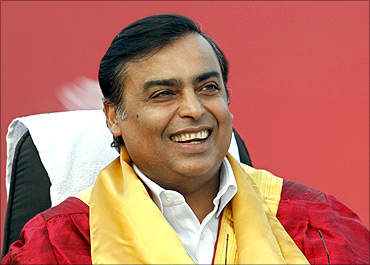
As the WEF summit draws to a close on Saturday, a few big names from India including Mukesh Ambani and Anand Mahindra were missing in action while Pakistan Prime Minister Nawaz Sharif and Jordan's King Abdullah II were among global leaders who cancelled their trips at the last moment.

The health system is trying to ensure that it isn't caught by surprise -- the way it was last time. So, hectic preparations are on.

rediffGURU Ramalingam Kalirajan answers your personal finance queries.

The share of Life Insurance Corporation of India (LIC) in monthly new business premium (NBP) in the life insurance sector declined to 58.50 per cent in September 2023 from 68.25 per cent in September 2022 -- a drop of 975 basis points -- owing to shortcomings in the product and distribution side of business. However, the market share saw a marginal uptick from the 57.37 per cent recorded in August this year. According to the monthly business data released for September 2023 by the Life Insurance Council, the NBP of LIC up to September 2023 stood at Rs 92,462.62 crore as compared to about Rs 1.25 trillion in the same period a year ago.

From the Sensex pack, NTPC, Tata Motors, Titan, Larsen & Toubro, Reliance Industries, IndusInd Bank, Infosys, HDFC Bank and Power Grid were among the major gainers. Wipro and Tech Mahindra were the laggards.

Benchmark Sensex dropped 334 points on Monday due to intense selling pressure in metal and power stocks as FII outflows dampened investor sentiment. Besides, a sharp decline in the rupee against the US dollar also put pressure on domestic equities, traders said. After losing nearly 500 points, the 30-share BSE index recovered some lost ground to settle at 334.98 points or 0.55 per cent lower at 60,506.90. During the session, the index touched its intra-day low of 60,345.61.

Private players continued to show strong momentum in the life insurance individual new business segment during August, 2023. On an aggregate, the industry registered 14 per cent growth year-on-year (Y-o-Y) compared to 15 per cent in July '23. Private players were up 21 per cent Y-o-Y, up from 16 per cent Y-o-Y in July '23, while public insurers' growth was muted at 3 per cent.

From the Sensex pack, ITC jumped 4.74 per cent. The other major gainers were IndusInd Bank, Hindustan Unilever, Infosys, Wipro, HCL Technologies, Tata Consultancy Services and ICICI Bank. HDFC, Tata Steel, Bajaj Finance, NTPC, Power Grid and HDFC Bank were the major laggards.

'Check every SMS you get. Many people ignore them.' 'Remember if there is an activity in your account, your financial institution will send you an SMS, not a WhatsApp message.'

The GST Council has set up a Group of Ministers, chaired by Haryana Deputy Chief Minister Dushyant Chautala, to suggest required changes in the law for setting up the GST Appellate Tribunal (GSTAT). The GST Council, chaired by Finance Minister Nirmala Sitharaman and comprising state ministers, had last week decided to constitute a Group of Ministers (GoM) to address various concerns raised by states in relation to constitution of the GSTAT. As per the Terms of Reference (ToR) of the GoM, the panel would recommend required amendments in the GST law to ensure that the legal provisions maintain the right federal balance and are in line with the overall objective of uniform taxation within the country.

'The deal pipeline across products is robust for 2024.'

ITC, Sun Pharma, Maruti, M&M, Tata Motors, HCL Tech, Wipro, Infosys, HUL, Bharti Airtel and Reliance were among the major losers. Kotak Bank rose the most by 1.59 per cent, followed by IndusInd Bank, Bajaj Finance and Bajaj Finserv. L&T, SBI, TCS and HDFC Bank also closed higher.

Indian corporate are fast tapping the international bonds market to raise funds for their operational expenses even as they reduce their presence in the rupee bond market. As bonds are costlier for companies and investors are more sceptical than the banks, chief financial officers say they are looking at other avenues for raising funds in the coming months as dollar bond rates are lower in the range of 100 to 250 basis points. "For corporate with reasonable credit quality, the Indian bond market has become less of an option from a cost point of view. "In addition, conditions imposed in the Indian bond market by investors post Franklin episode have also become very onerous," said Prabal Banerjee, president-finance of Bajaj group. "Hence very few corporate are looking at the local bond market for resource mobilisation, since both, bank loans and the overseas bond markets are much more attractive," he said.

M&M was the biggest loser in the Sensex chart, falling 6.39 per cent, followed by Tech Mahindra, Nestle India, Bajaj Finance, Axis Bank, ITC, JSW Steel, HDFC Bank and RIL. On the other hand, Sun Pharma, Tata Motors, Bharti Airtel, L&T and Infosys were among the winners, rising up to 2.10 per cent.

Sugar prices are hovering near six-year highs, leaving a bad taste in Indian consumers' palates but sweetening the portfolios of investors in related stocks at Dalal Street. Shares of sugar manufacturers such as Piccadily Agro, DCM Shriram, Magadh Sugar, and Bajaj Hindustan have rallied up to a whopping 200 per cent so far in the financial year 2024 (FY24) as deficient monsoon rains in major sugarcane producer states like Maharashtra and Karnataka are expected to lead to a shortfall in sugar output ahead. In comparison, the BSE Sensex has modestly gained 11 per cent during this period.

The government intends to continue with the top GST slab of 28 per cent for luxury and sin goods, but is open to discuss narrowing down the three slabs of 5, 12 and 18 per cent into two, Revenue Secretary Tarun Bajaj said on Monday. Addressing the industry leaders, Bajaj said the rate rationalisation exercise of the GST Council is a result of introspection of GST, five years after its rollout, and the policymakers do not have a "fetish" to raise the tax rates to the revenue-neutral level of 15.5 per cent. On the industry demand for bringing petroleum products under GST net, he said since fuel constitutes a larger part of their revenues, both the Centre and states have some apprehension.

Wall Street-correlated stock markets are facing the risk of correction, as Christopher Wood, the global head of equity strategy at Jefferies, conveys to investors in his latest edition of GREED & fear. Rising crude oil prices, which are nearing $100 a barrel (Brent), pose a threat to the global central bank's battle against inflation and have led to a re-evaluation of its exposure to Indian stocks. "The potential for more US Federal Reserve (Fed) rate hikes, combined with the risk that monetary tightening finally bites as regards the economy, remains a risk for Wall Street-correlated world stock markets. "There is also the oil factor. This is why GREED & fear continues to believe the pain trade is down. "Areas in Asia, such as Indian midcaps, which have already done very well, are at obvious risk of some profit-taking," writes Wood.
The K-shaped economic recovery in India from the pandemic slowdown shows in corporate results as well. The automobile sector, which represents big-ticket consumption, continues to do well and has increased its share in corporate revenues and profits while fast-moving consumer goods (FMCG) companies that sell low-ticket consumer goods are struggling with poor sales and earnings growth. The share of the automobile sector, including makers of auto ancillaries, in corporate net sales rose to a 10-quarter high of 10.05 per cent during July-September 2023 (Q2FY24) from 8.94 per cent a year earlier and 9.75 per cent in Q1FY24.

The National Stock Exchange (NSE) Nifty Next 50 Index could undergo large-scale changes if the proposed tweaks to its computation methodology get implemented. In a discussion paper floated recently, NSE Indices, which owns and manages a portfolio of over 350 indices under the Nifty brand, proposed that only stocks that are traded in the futures and options (F&O) segment can be part of the index. Currently, as many as 11 non-F&O stocks are part of the Nifty Next 50 Index, which, as the name suggests, represents the next rung of large and liquid securities after the Nifty50.
In line with the overall downtrend in the markets, a majority of large business conglomerates saw their valuations taking a dip.

Besides the pandemic that resulted in higher interest rates, the default by Future Retail has dealt a blow to investor sentiment.

The third-quarter financials didn't excite market watchers. But equity investors can still make money if they invest in the right stocks.

Realty major DLF's chairman Rajiv Singh remains the wealthiest Indian real estate entrepreneur with a wealth of Rs 59,030 crore, according to GROHE-HURUN India. With a wealth of Rs 42,270 crore, Mangal Prabhat Lodha and his family of Mumbai-based Macrotech Developers (Lodha Group) is at the second position. Arjun Menda & family of Bengaluru-based RMZ Corp debuted at the third position on the list, with a wealth of Rs 37,000 crore.

It will also be new Revenue Secretary Sanjay Malhotra's first GST Council meeting. He will take charge after the incumbent Tarun Bajaj retires on November 30.
To ease pressure due to the coronavirus lockdown, corporate have asked banks and the government for a six-month liquidity line, so that they can pay off their suppliers and employees.

After three consecutive years of infusing huge funds, foreign portfolio investors retreated from the Indian equity markets in a big way in 2022 with the highest-ever yearly net outflow of nearly Rs 1.21 lakh crore. The huge outflow, which surpasses by a big margin the previous record of Rs 53,000 crore net withdrawal in 2008, came amid aggressive rate hikes by central banks globally but 2023 is expected to be better on positivity about overall macroeconomic trends in India, experts said. Apart from global monetary tightening, volatile crude, rising commodity prices along with Russia and Ukraine conflict led to an exodus of foreign money in 2022.
